
Buying a house is a thrilling experience, but it also is a very serious legal and financial move. You are buying an expensive land with boundaries, rights, and sometimes hidden issues that you are unable to see with your eyes. That is where a property survey comes in. A property survey shows your property lines, along with the land, structures and features which you legally own. It can also indicate where your neighbour’s land starts, and where you are not allowed to cross the land.
Many buyers have asked us if they really need a survey, and in particular, if they are already paying for an inspection and an appraisal. It can feel like one more bill during a stressful time. But are you comfortable spending thousands of dollars with no clear map for you to know what you own and what you do not own? Let us answer your concerns so you can decide on when it may be a good idea to order a survey and when it may not be necessary at all.

What Is a Home Survey and Do You Need One?
A home survey is a written and drawn report that is prepared by a licensed surveyor. The surveyor comes to the property, measures the land and makes the exact marks to indicate where the boundaries are. The last survey photograph displays the layout of the lot, size, and location of the house, the driveway, fences, sheds, decks, and any other permanent features. It may also reveal such things as utility lines, shared driveways and easements, where others have a legal right to use part of the land.
A survey is different from a home inspection and an appraisal. An inspection tells you about the condition of the house while an appraisal provides a value for the house and land for the lender. A survey, however, calls for answers to a different set of questions. This tells you the exact location of the land you are buying, does the house fit completely inside the lot, does this lot have any boundary problems. And, in many cases the answer is yes, especially if you are buying a single family house or making changes in the future or not sure about the property lines.
Property Survey Basics
A property survey helps you to be protected from surprises. It establishes that what is stated in the legal description in your contract is what it is on the ground. For example, the listing may say the lot is a certain width and length but only a survey can make it. The survey may indicate that there is a fence in your land or a neighbor’s garage covers the line slightly.
Without a survey you may shut the sale on a house and then also close up to find that half of your driveway is on your neighbor’s land or that your planned addition is not allowed due to set-back requirements. Sorting this out after closing may be expensive and stressful. That is why so many careful buyers have a survey included in their due diligence efforts, in addition to inspection and title work.
Types of Property Surveys Explained
There is more than one kind of survey. The type you need depends on your plans and what your lender or attorney recommends. Understanding the main types will help you ask for the right one.
Boundary or Lot Survey
A boundary survey is done focusing on the exact lines of the land. The surveyor locates or establishes markers at each of the corners of the lot and maps out the lines between them. This is the kind of survey that most buyers are thinking of when they say “I want to see my property lines.” It is very useful if there are fences, trees or sheds near the edges, or neighbors have doubts as to where one yard ends and the other begins.
Location Survey
A location survey indicates the lines and the position of the house and other buildings in relation to said lines. It helps determine that the home and other buildings comply with the local rules as to how far from the street and from other properties they must be.For most typical home purchases, these sorts of surveys are very common because this type of survey combines lot lines with building placement.
Mortgage or Lender Survey
Sometimes a lender or title company requests a survey simply to ensure that the house is actually on the land that is being financed and there are no obvious problems. This is commonly referred to as a mortgage survey. It is not as detailed as a full boundary survey, but it will present a basic picture of the property. Buyers who wish to have a deeper peace-of-mind may opt for a more complete survey anyway, even if the lender only required a limited survey.
Topographic Survey
A topographic survey is a survey that indicates the shape and elevation of the land. It includes hills, dips, retaining walls, etc., which have an impact on drainage and building plans. You usually see something like this survey in action when somebody is planning to build a new home, add a big extension or do major landscaping. If you already know that you think you want to add another level, a pool or large patio etc, this kind of survey can be very helpful.
New Construction or Stake Out Survey
For a brand new build, surveyors often perform stake out surveys. They set marks on the precise locations where the new house or structure can be placed as per the plans registered. In the case that you are purchasing a lot and constructing from the ground up, your builder and architect will most likely use this type of survey to ensure that everything is in the correct locations and within legal boundaries.
Benefits Of Survey Before Buying Properties
Ordering a survey before you buy is an extra step, but it comes with strong benefits. It gives you clarity today and prevents headaches tomorrow. Think of it as a small investment that protects a much bigger one.
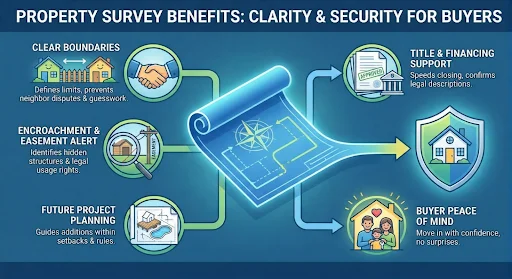
Clear Boundaries and Fewer Neighbor Disputes
One of the major advantages is to avoid fights with neighbors in the future. With a survey in hand, you will know exactly where your land starts and ends. If the neighbour is saying you have put a fence on their side, you can show them the survey and not argue with them based on guess work. Clear lines can also be used to configure your gardens, play areas, and outdoor work, without the fear of straying too close to everyone else’s garden.
Protection Against Encroachments and Easements
A survey may disclose encroachments which are basically structures that go across property lines. For instance, a portion of a garage, a deck, or a fence on your property or your neighbor’s property. It also can display easements, which are legal rights for others to use part of your land to do something such as for utilities, shared driveways or pathways. Knowing these before closing will help you understand whether you are comfortable or not, negotiate repairs or request the seller to fix this issue.
Better Planning For Future Projects
If you dream of adding a patio, a pool, or a room then a survey will be beneficial for you. It reveals to you how much usable land you actually have once you respect setbacks, easements, and current structures. This helps plan safely within the rules with your contractor. Without a survey, you may design a project and get it rejected by the town or cost a lot of money for redesign.
Support For Title Insurance and Financing
Title companies and lenders love to have clear information. When you give them a recent survey,it helps them confirm that the legal description, the lot lines, and the actual house all match. This can lead to the closing being faster and minimize the possibility of last minute problems. It also means that if there is some type of that boundary issue that comes up in the future that may have stayed hidden, you have better proof available to support a title insurance claim.
Peace Of Mind For Buyers
Buying a home is emotional, especially if the family intends to stay in the home for many years. Knowing that you are getting exactly what is mentioned in the contract without any unknown strips of land and without any surprises about building limits, helps you move in with confidence. A survey will not eliminate all risks in a real estate deal, but it shuts one large gap in your knowledge.
Who Orders the Survey When Buying a House?
In many areas, the purchaser is the one who orders and pays for the survey, frequently upon the advice of their real estate agent or attorney. Sometimes the lender or title company will also request a survey, and these may make the arrangements from their usual partners. The cost may vary depending on the size of the lot, location, and the type of survey requested.
If the seller has any type of recent survey they may offer to share that. This can be helpful, but you should still check how old it is and whether any changes were made to the property since then. New fences and additions or even neighbors can make an old survey inaccurate. In many cases, buyers choose to order a fresh survey in their own name so that the report reflects the current situation and supports their title coverage.
Should a Buyer Always Order a Survey?
In some rare cases, like a condo where the land is owned by an association you may use existing documentation. In many house purchases though, especially the single family home with a yard, a buyer must order a survey. The cost of a survey is nothing in comparison to the risk of boundary fights, blocked building plans or missing pieces of land.
If you are concerned about where your yard begins and ends, or you have plans to build or change things, or if anything at the edges looks uncertain, a survey is money well spent. Even when it is not legally required, it can save you from unexpected problems that only manifest themselves long after the moving boxes are unpacked.
Conclusion
A home purchase is a legal package of land, rights, and limits that will determine your daily life for years. A survey helps in shining a light on this side of the deal. It shows your property lines and your land boundaries, as well as any structures on your land, and features that affect what you can and cannot do. In simple words, instead of guesswork and stories, it has ample representations in the form of measurements and drawings.
If you are purchasing or selling your home on Long Island, and feel uncertain about issues concerning survey, you do not need to work it out all alone. Kaya Homes deals with buyers and sellers daily and are aware of local lot layouts, town rules and common survey issues in the area. Reach out to us so that your next move in Long Island is protected and well informed.
Frequently Asked Questions
Q1. Is a survey required for every home purchase?
Not always. Some lenders or title companies might not require a survey, especially for certain types of properties. However, even if not required, many buyers decide to order one as protection of their own, if they are buying a house with a yard.
Q2. How much does a property survey usually cost?
The cost depends on the size of the lot, the location, and the type of survey you need. Larger or irregular lots often cost more because they take longer to measure. Your agent or attorney can suggest local surveyors and give you a realistic price range before you decide.
Q3. Can I use an old survey from the seller?
You can look at an old survey, and it can be a helpful starting point. However, if there have been alterations of the property or nearby lots, it may not reflect the current reality. Many buyers take out a new survey in their own name to have up to date information and better support for title insurance.